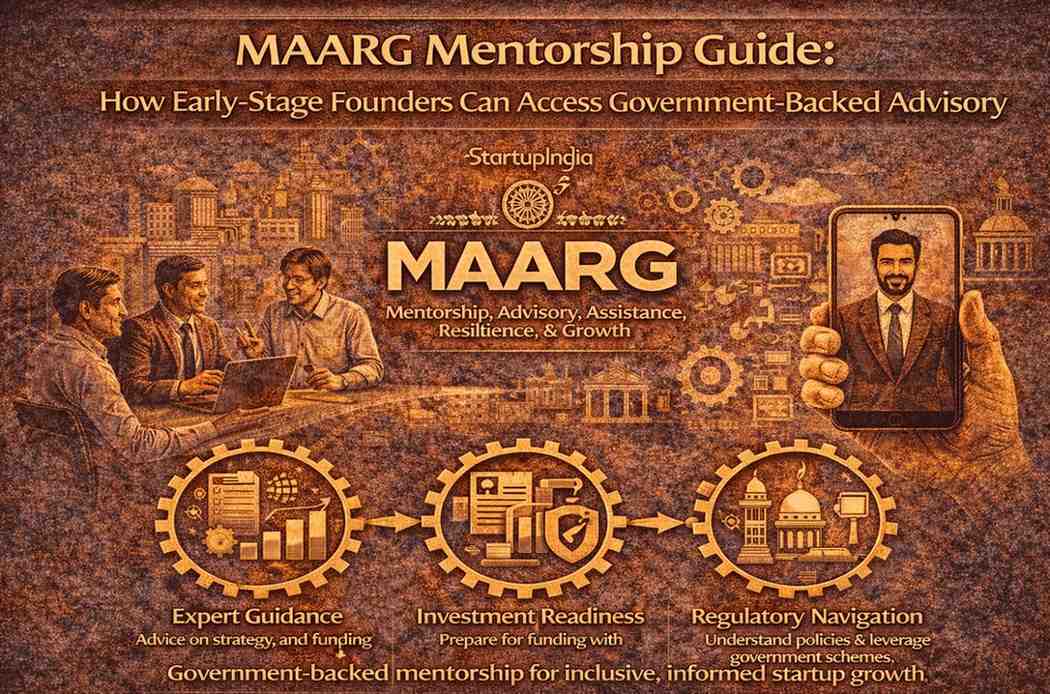
MAARG Mentorship Guide: How Early-Stage Founders Can Access Government-Backed Advisory in 2026
As India’s startup ecosystem matures, early-stage founders are increasingly recognising that capital alone is not enough to build sustainable businesses. Strategic guidance, market access, regulatory clarity, and operational mentorship have become equally critical. In this context, the MAARG mentorship platform has emerged as a key government-backed initiative aimed at supporting startups with structured advisory support. As 2026 approaches, understanding how MAARG works and how founders can leverage it effectively is becoming essential for entrepreneurs navigating India’s competitive startup landscape.
What Is MAARG and Why It Was Launched
MAARG, short for Mentorship, Advisory, Assistance, Resilience, and Growth, is a national mentorship platform launched under the Startup India initiative. Designed to connect startups with experienced mentors, the platform focuses on addressing one of the most common gaps faced by early-stage founders: access to credible, affordable, and relevant advisory support.
The government’s intent behind MAARG is to democratise mentorship. By creating a centralised, transparent platform, policymakers aim to ensure that founders across geographies, sectors, and backgrounds can benefit from expert guidance, not just those with access to elite networks.
Role of Government-Backed Mentorship in the Startup Ecosystem
Government-backed mentorship differs from informal advisory in both structure and intent. MAARG is anchored within the broader Startup India framework, overseen by Department for Promotion of Industry and Internal Trade. This gives the platform institutional credibility and alignment with national policy priorities.
For founders, this means mentorship that goes beyond generic advice. Guidance often includes regulatory navigation, government schemes, compliance requirements, public procurement opportunities, and sector-specific growth pathways that align with India’s economic goals.
Who Can Access MAARG in 2026
MAARG is primarily targeted at early-stage startups, including idea-stage ventures, seed-funded companies, and founders preparing for their first institutional raise. Startups recognised under Startup India are eligible to apply for mentorship through the platform.
The focus is on inclusivity. Founders from Tier 2 and Tier 3 cities, women entrepreneurs, and startups working in emerging or socially impactful sectors are encouraged to participate. By 2026, the platform is expected to expand its mentor base and sector coverage further.
How the MAARG Mentorship Process Works
The MAARG platform operates through a structured matching process. Founders begin by registering their startup, outlining their sector, stage, and specific mentorship needs. Mentors, who include industry veterans, functional experts, investors, and policy specialists, list their areas of expertise and availability.
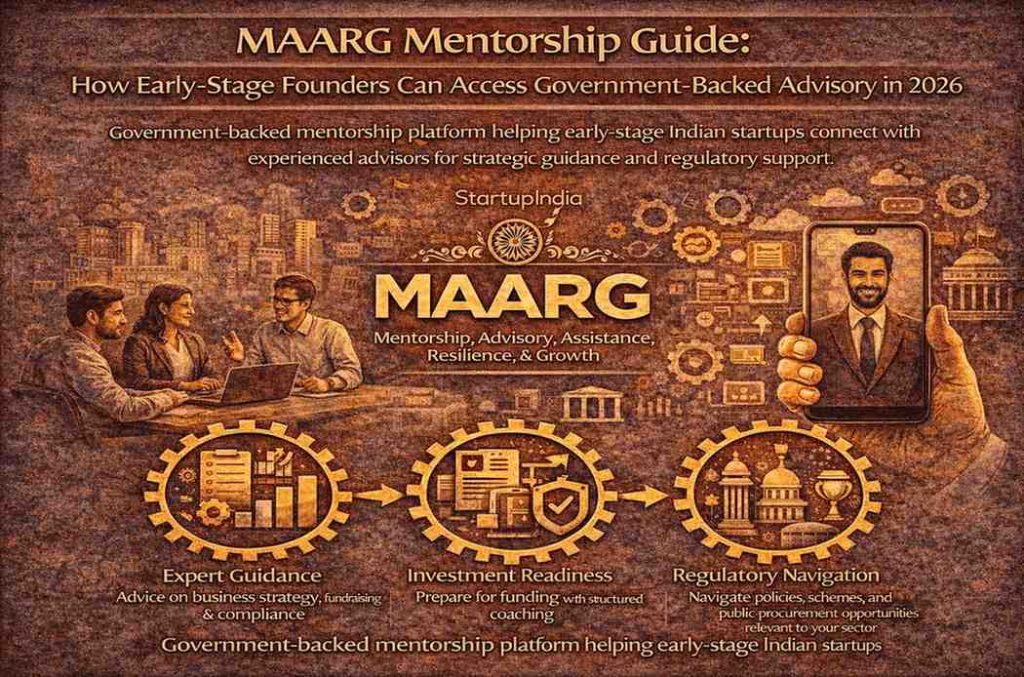
Based on alignment, startups are matched with mentors for focused advisory engagements. These sessions may cover business strategy, go-to-market planning, fundraising readiness, compliance, technology scaling, or organisational design. The emphasis is on actionable guidance rather than one-off interactions.
Types of Advisory Support Available
MAARG mentorship spans multiple dimensions of startup building. Founders can seek guidance on refining business models, validating market assumptions, and building scalable operations. For startups in regulated sectors, mentorship often includes compliance planning and policy interpretation.
Another important area is investment readiness. Mentors help founders understand investor expectations, improve pitch narratives, and strengthen governance practices. As funding becomes more selective, this kind of preparation is increasingly valuable.
Why MAARG Matters More in 2026
The startup environment in 2026 is expected to be more disciplined than the boom years of the early 2020s. Investors are prioritising fundamentals, profitability paths, and governance. At the same time, regulatory oversight in sectors such as fintech, health-tech, and climate-tech is increasing.
In this environment, access to credible, policy-aligned mentorship can be a competitive advantage. MAARG helps founders anticipate regulatory shifts, align with national priorities, and avoid common early-stage mistakes that can slow growth or derail fundraising.
Integration With Other Government Startup Schemes
One of MAARG’s strengths is its integration with other government initiatives. Mentors often guide founders on how to leverage schemes related to funding support, incubation, public procurement, and innovation challenges.
This interconnected approach helps startups navigate what can otherwise be a complex policy ecosystem. Rather than viewing government support as fragmented, MAARG positions mentorship as a gateway to broader institutional resources.
Challenges and Limitations to Be Aware Of
While MAARG offers significant value, founders should approach it with realistic expectations. Mentorship quality can vary depending on mentor availability and alignment. Outcomes also depend heavily on how well founders prepare for sessions and implement advice.
Additionally, government-backed platforms tend to emphasise structure and compliance, which may feel slower compared to informal networks. Founders who treat MAARG as a long-term support system rather than a quick fix are more likely to benefit.
How Founders Can Maximise Value From MAARG
To make the most of MAARG in 2026, founders need to be clear about their objectives. Entering the platform with specific questions, challenges, and data improves the quality of mentorship interactions. Regular follow-ups and measurable action points help convert advice into outcomes.
Combining MAARG mentorship with other sources of learning—such as accelerators, peer networks, and customer feedback—creates a more balanced support system. MAARG works best as a complement, not a replacement, to entrepreneurial initiative.
What This Means for India’s Startup Ecosystem
MAARG reflects a broader shift in how the government supports entrepreneurship. The focus is moving from just enabling startup creation to improving startup quality and resilience. By institutionalising mentorship, policymakers aim to reduce early failure rates and build globally competitive companies.
For early-stage founders, the message is clear. In 2026, success will depend not just on ideas and funding, but on access to the right guidance at the right time.
The Road Ahead
The MAARG Mentorship Guide is becoming increasingly relevant as India’s startup ecosystem matures. By offering structured, government-backed advisory support, the platform fills a critical gap for early-stage founders navigating complexity and uncertainty.
How early-stage founders can access government-backed advisory in 2026 will depend on awareness, preparation, and proactive engagement. Those who use MAARG strategically are likely to gain not just advice, but perspective—helping them build stronger, more resilient startups in a demanding and competitive landscape.
Also read – https://republicpost.in/a-beginners-guide-to-investing-in-gold-and-silver-during-market-volatility/
Add republicpost.in as preferred source in google – click here
Last Updated on: Tuesday, January 27, 2026 10:56 am by Republic Post Team | Published by: Republic Post Team on Tuesday, January 27, 2026 10:56 am | News Categories: India
About The Author